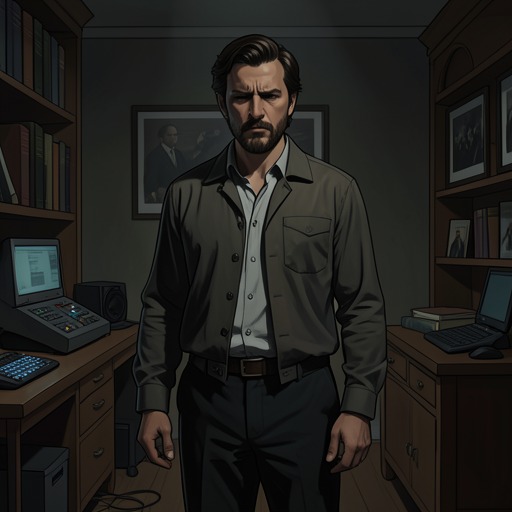
Sortilège
Inherent ViceSortilège is a former associate of Doc Sportello whose practical knowledge of people and esoteric attentiveness make her an important guide through the novel’s uncertain boundary between ordinary life and the supernatural. She diagnoses emotional and physical problems, helps Doc seek out Shasta Fay Hepworth, and supplies a spiritual framework in which personal memory, the Pacific’s history, and the present may be connected. Her belief in such connections gives her role both intimate and mythic dimensions: she is a friend who can read Doc’s distress, and a voice through which the possibility of Lemuria’s return enters the story.
Identity and Work
Sortilège once worked in Doc’s office. In Doc’s recollection, she left the job after her boyfriend Spike returned from Vietnam, choosing love over a day job. She subsequently put her abilities to other uses: she could diagnose and address emotional and physical problems, drawing on what Doc understood as contact with invisible forces. She generally offered this help for free, sometimes accepting weed or acid instead of money. Doc recalls that, as far as he knew, she had never been wrong.
Her manner combines familiarity with an assured, unsentimental eye. When she examines Doc’s hair, he reacts with defensive panic; she concludes that he should do something about it and repeats her conviction that changing one’s hair can change one’s life. The advice is light in form but characteristic in function: Sortilège notices a problem Doc would rather avoid and treats change as something he can choose, however modestly.
A Guide to Doc and Shasta
After Shasta leaves, Doc walks with Sortilège through Gordita Beach at dawn. She understands why he needs to talk: he has heard that Shasta has left the country. Rather than keeping the conversation at the level of his regret, Sortilège points him toward Vehi Fairfield, saying that Vehi is the person most likely to put him in touch with Shasta. She also recognizes a complication Doc would prefer to evade: Vehi thinks Doc has been avoiding him and does not understand why. Her intervention therefore links Doc’s search to an old, uneasy relationship as well as to his absent former partner.
Sortilège’s guidance is not a claim that events can be neatly explained. When Vehi links Manson and the Surge of ’69, she observes that he thinks everything is connected. The remark registers her own proximity to that way of seeing while keeping a measure of distance from it. She can take spiritual possibilities seriously without presenting every proposed connection as settled fact; in practice, her insight helps Doc orient himself amid people and circumstances he cannot readily interpret.
Lemuria, Surf, and the Pacific
At Wavos, Sortilège listens while Ensenada Slim recounts the surfers’ stories about Death’s Doorsill, a dangerous break said to appear and disappear. She offers another way to read what Flip saw: a patch of breaking surf in deep water might signal an island that sank long ago and is slowly rising again. Her suggestion turns a local surfing legend into a possible sign of buried history returning to the surface. The speculation anticipates the novel’s repeated movement between what is hidden beneath the Pacific and what might reappear in the present.
Her interest in that lost past intensifies during the prolonged rain. Sortilège becomes obsessed with Lemuria and tells Doc that she dreams about it; Spike shares the dreams. They feel unable to find a way back to Lemuria and imagine instead that it is returning to them, rising out of the ocean. In this vision, a drowned place does not remain safely in the past. The rain becomes the condition through which a suppressed or vanished world seems capable of entering ordinary life again.
Spiritual Instruction and the Ouija Board
Sortilège’s ideas also shape Doc’s memory of a practical episode from his relationship with Shasta. During a period when drugs were scarce and people tried various desperate substitutes, Doc and Shasta visited Sortilège at home. Doc asked whether her Ouija board could tell them where to find drugs. When suspicions arose that a second person might be moving the planchette, Sortilège suggested that Doc use it alone. Following her instructions, he tried to enter a receptive state and placed his fingertips lightly on the planchette. It moved quickly, spelling out an address and phone number; when Doc called, a woman offered drugs and urged him to come soon, then hung up when he asked who she was.
The apparent answer did not lead to a dealer. Doc and Shasta eventually reached the address through traffic and accidents, only to find an empty, flooded excavation. Sortilège later explained the mismatch through mischievous spirits just beyond human perception, occupying both worlds and taking pleasure in frustrating human desire. Her interpretation makes the board episode more than a failed attempt to obtain drugs: it demonstrates how a message can be both compelling and treacherous, and how Doc’s appetite for a clear answer may expose him to misdirection. The scene also gives a concrete form to her recurring insistence that the visible world may not exhaust what is acting within it.
Memory and Narrative Significance
Sortilège reappears in one of the novel’s quieter moments after Doc’s encounter with Vehi. She calls his name while they are outside on the beach at night, with Vehi gone and the ocean nearby. When Doc begins to explain his experience, she warns him not to begin by telling her about his trip. The exchange joins her attentiveness to her refusal to let spiritual talk become an automatic explanation: she is present for Doc, but also knows the habits through which he may turn an experience into a story.
Much later, Doc dreams that the schooner Golden Fang has recovered its former working identity and its real name, Preserved. In the dream, an exorcist has cleared the vessel of the dark residue of blood and betrayal and helped its dead rest. The narration associates this work with the Zen exorcist Coy had told Doc about, who had also restored the Boards’ mansion in Topanga. Sortilège is not the exorcist in this account, but her established concern with invisible forces and Lemuria gives the dream’s language of spiritual residue and release a wider resonance. The ship’s imagined cleansing is set against Sauncho’s reflection on time, memory, and the future that remains after California’s better possibilities have been lost.
Near the end, Sortilège’s account of Lemuria supplies a final image of California as both refuge and precarious ground. She has said that some survivors of the continent’s destruction may have fled there, making California something like an ark. The thought is immediately tested against the instability of the place itself. Her spiritual history does not resolve that contradiction; it makes it legible. In Sortilège’s perspective, old catastrophes may persist in the present, and a refuge may carry the traces of the disaster from which it claims to offer shelter.